Perfume Notes Explained: Top, Heart & Base Notes (A Perfumer's Guide)
My husband Neerav is the perfumer in our family. I am the one who asks him annoying questions while he works. The question I asked most in our first year was this: why does a perfume smell like one thing in the bottle, another thing at lunch, and something else entirely by dinner? His answer is the whole subject of this post.
What are perfume notes? The short answer
Perfume notes are the individual scent impressions you detect as a fragrance unfolds on your skin. They arrive in three stages. Top notes are what you smell in the first 15 to 30 minutes. Heart notes (also called middle notes) emerge as the top fades and carry the fragrance for the next few hours. Base notes are the deep, slow materials that anchor everything and stay on your skin until the very end. Together they form what perfumers call the fragrance pyramid.
The fragrance pyramid
| Stage | When you smell it | Typical materials | Its job |
|---|---|---|---|
| Top notes | First 15-30 minutes | Citrus, herbs, light fruits, aromatics: bergamot, bitter orange, mint, basil | The greeting. Bright, volatile molecules that make the first impression and leave first. |
| Heart notes | 30 minutes to 4 hours | Florals and spices: jasmine, rose, lily, saffron, clove, cardamom | The character. This is the fragrance you actually live in for most of the day. |
| Base notes | 4 hours to end of wear | Woods, resins, musks, gourmands: sandalwood, patchouli, oud, amber, vanilla, tonka | The memory. Heavy molecules that fix the lighter ones to your skin and become the drydown. |
Why perfume smells different after an hour
Nothing mysterious is happening. It is simple physics with romantic consequences. Every material in a perfume evaporates at its own speed. Small, light molecules like citrus lift off your warm skin quickly, which is why no fragrance smells like its opening for long. Larger, heavier molecules like sandalwood and musk evaporate slowly, sometimes over twelve hours. A well-built perfume is choreography: the perfumer decides who enters, who overlaps, and who stays for the quiet last hour.
Neerav puts it this way: the top note is what convinces you to buy a perfume, and the base note is what makes you repurchase it. When people say a fragrance "turned" on them, they usually mean they loved the greeting and never met the drydown before committing. This is also why we insist on wearing a scent for a full day before judging it, and why how long a perfume lasts depends mostly on those base materials.
Reading a real pyramid: two of ours
Abstract lists mean little until you smell them move, so here are two examples from our own studio.
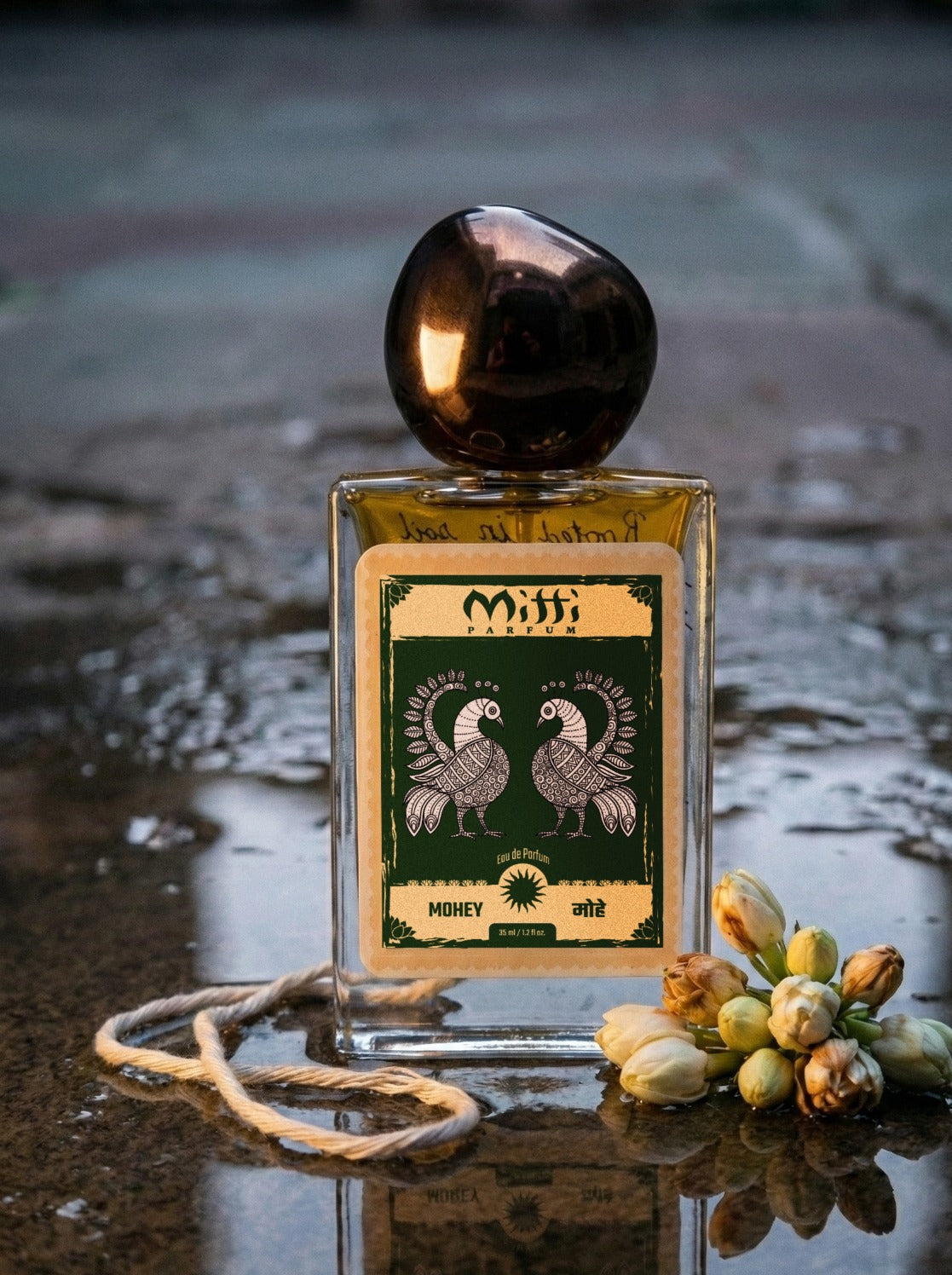
MOHEY opens with bitter orange and sweet lime, a bright, almost sparkling greeting. Within the hour, jasmine and petrichor take over the heart, the smell of the first rain on warm earth. By evening you are left with patchouli, soft and grounding, like wet soil remembered rather than smelled. Three acts, one story.
RUH works in the opposite direction. It is built base-first: vanilla, tonka, sandalwood, and musk, with rose and saffron in the heart. The opening is quiet on purpose. Ruh is designed to be a skin scent, a fragrance that sits close and reveals itself only to the people allowed near you. Not every pyramid wants to project.
How to read a notes list when you shop
- Notes are impressions, not ingredients. A note list is the perfumer telling you what you will perceive, not a recipe. "Morning dew" is not an ingredient you can farm. It is an accord, a blend built to evoke that exact feeling.
- Look at the base first. The base is where you will live longest. If you dislike patchouli or heavy musk, no amount of pretty top notes will save the relationship.
- Two perfumes with the same notes can smell nothing alike. Proportion is everything. Rose at two percent whispers; rose at twenty percent gives a speech.
- Concentration changes the timeline. An eau de parfum stretches every stage longer than an eau de toilette. We explained the full breakdown in our EDP vs EDT guide.
The only honest way to test notes
Paper strips tell you the top notes. Only skin tells you the truth, because your warmth and chemistry set the tempo of the whole pyramid. Spray, then wait through at least one full drydown before deciding anything. It is exactly why we built our Discovery Set: five complete pyramids, worn on your own skin, on your own days, before you commit to a full bottle.
Frequently asked questions
What are top notes in perfume?
Top notes are the lightest, most volatile materials in a fragrance, usually citrus, herbs, and bright aromatics. You smell them immediately after spraying and they fade within 15 to 30 minutes.
What are heart or middle notes?
Heart notes form the core of the fragrance once the top notes fade, typically florals and spices like jasmine, rose, and saffron. They carry the scent for several hours and define its character.
What are base notes and which last longest?
Base notes are the heaviest, slowest materials: sandalwood, oud, patchouli, amber, musk, and vanilla. They can last eight hours or more and are what remains on your scarf the next morning.
Are perfume notes the same as ingredients?
No. Notes describe what you will smell, not what is in the vat. Many notes are accords, which are compositions of several materials built to evoke a single impression, like rain or dew.
Why does perfume smell different on my skin than on my friend?
Skin temperature, oiliness, and pH all change how fast each layer of the pyramid evaporates. The perfume is the score; your skin is the instrument.
Written from our studio in Delaware, where Neerav composes and I take notes on the notes. If you want to feel a pyramid move through its three acts on your own skin, start with all five of ours.
Curious where to begin?
The Discovery Set · $52 →